

 English
 Español
 русский
News
Home / News / Industry News / Hydraulic Door Hinges vs Traditional Hinges: Which Is Better for Heavy Doors
Modern construction projects no longer treat doors as basic opening-and-closing panels. Today's doors are built to bear significant weight, withstand constant daily use, and guide pedestrian flow throughout a space. As builders opt for larger, hydraulic door hinges for heavy doors designs, hardware selection has grown far more critical — especially when choosing between hydraulic door hinges and standard traditional hinges.
This selection is no longer just a matter of basic functionality. It now ties directly to user safety, daily usability, long-term durability and consistent design effects. For heavy-duty doors, the type of hinge installed creates subtle yet impactful differences in day-to-day building operation.
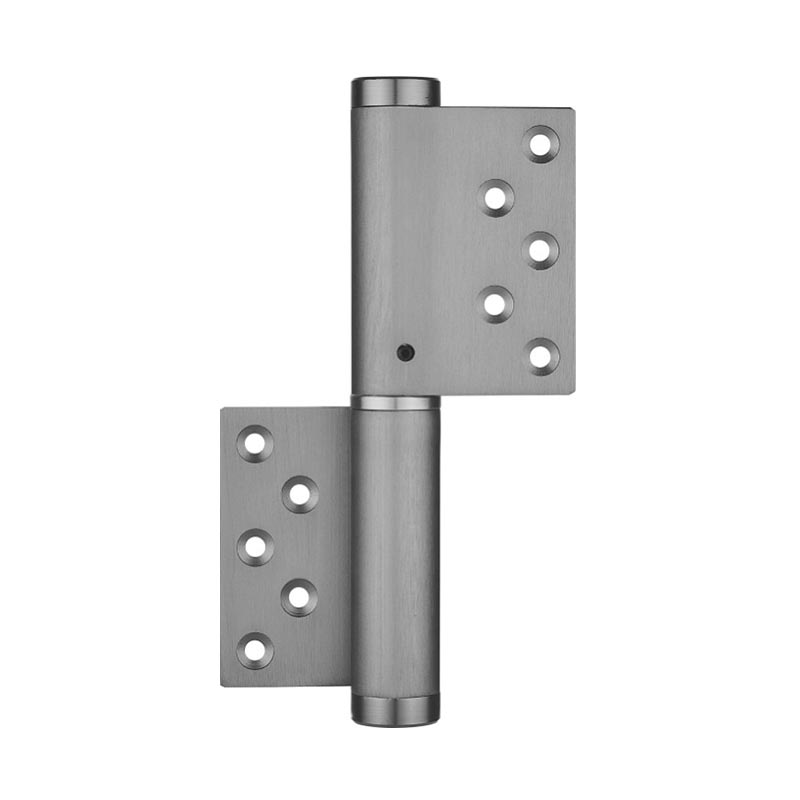
A hydraulic door hinge isn't just a connector — it's got a built-in control system that actually manages how the door moves. Regular hinges just link a door to its frame and call it done. This kind does more: it governs swing speed and takes charge of the whole closing motion from start to finish.
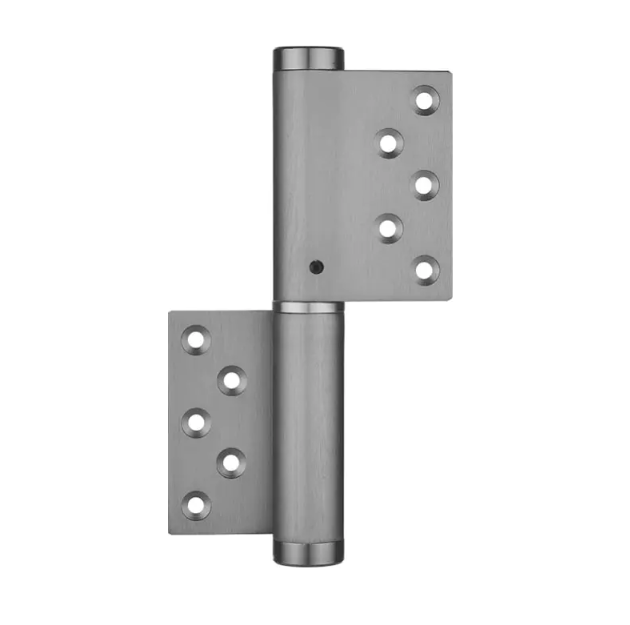
The mechanism behind it relies on fluid to smooth out abrupt movement. Push the door open, and the hinge lets it swing freely with no resistance fighting you. Let go, though, and instead of the door swinging wild or slamming shut on its own, the hinge eases it closed at a steady, controlled pace.
Where this really earns its keep is anywhere stability matters more than simplicity — heavy doors, high-traffic entries, anywhere a slam would eventually become a problem rather than just an annoyance. Cutting down on that impact force is basically the whole point.
Traditional hinges haven't stuck around by accident. They're about as simple as door hardware gets — a pivot point, nothing more. No internal mechanism trying to slow anything down or manage how forcefully a door swings shut.
That simplicity is actually the selling point. Installation is straightforward, replacement parts are everywhere, and for a standard door that only sees light or moderate daily use, there's really no need for anything fancier. Reliable and low-maintenance covers most of what people need.
Where it falls short is anywhere the door itself starts working against the hinge — heavy doors, doors that get used constantly throughout the day. Since there's nothing built in to control speed or closing force, all of that falls on either an add-on closer or, less reliably, whoever happens to be walking through at the time.
A heavy door doesn't behave like a lightweight residential one, and the difference isn't subtle. More mass means more momentum on every swing, and that changes how the door opens, how it closes, and how much stress it puts on the frame and hardware holding it in place.
A few problems tend to show up consistently with heavier doors:
Once a door gets to that weight and usage level, the hinge stops being a minor connecting part. It becomes one of the things actually determining whether the door stays safe to use and how long it lasts before something needs replacing.
Hydraulic hinges add a layer of precise motion control that traditional hinges simply cannot provide on their own, governing every stage of a door's swing range.
This regulated movement delivers tangible real-world benefits:
Soft, gradual closing
The door slows down automatically as it nears the frame, eliminating loud, damaging slams entirely.
Consistent, stable motion
Opening and closing movements remain smooth and uniform even after thousands of repeated uses.
Reduced structural impact
Minimizes sudden force transfer to door frames, walls and mounting fixtures, reducing structural wear.
Improved user experience
Doors feel lighter and easier to maneuver, making them ideal for busy commercial and public spaces with heavy foot traffic.
Traditional hinges can physically support the weight of heavy doors, but they cannot regulate how those doors move. This flaw leads to persistent operational issues with long-term use.
Common problems include:
To fix these issues, users must install separate accessories like door closers or door stops. While effective, these extra parts complicate the overall door setup and increase installation and maintenance costs.
The gap between the two hinge types becomes obvious when comparing their real-world performance across key operational metrics:
| Aspect | Hydraulic Door Hinges | Traditional Hinges |
|---|---|---|
| Movement control | Built-in control | No internal control |
| Closing behavior | Gradual and guided | Depends on external force |
| Noise level | Generally reduced | Can increase over time |
| Installation complexity | Slightly more involved | Straightforward |
| User interaction | Smooth and predictable | Varies by handling |
| Additional components | Often not required | May need extra devices |
This comparison shows the differences go beyond technical parameters — they directly shape daily usability and overall door performance.
Safety is a top priority for heavy, frequently used doors. Uncontrolled fast-closing doors pose obvious collision and pinching risks, especially in crowded public and commercial spaces.
Hydraulic hinges eliminate this hazard by actively limiting closing speed. The door shuts at a slow, controlled pace, greatly reducing accident risks even when pedestrians pass through quickly or inattentively.
Traditional hinges offer no such safety protection on their own. Safe operation relies entirely on user behavior or extra safety hardware. This works fine for low-traffic, quiet spaces but becomes a notable safety flaw in busy public environments.
Repeated daily movement creates continuous stress on doors and hardware. Hinge type directly determines wear degree, stability and long-term maintenance frequency.
Hydraulic hinges distribute movement pressure evenly across the entire door system. By absorbing sudden impact forces, they reduce abrasion on both the hinge and door frame, cutting down the need for frequent adjustments and repairs.
Traditional hinges boast long service life with proper use, but free, uncontrolled swinging will gradually throw the door out of alignment and loosen hardware stability over time.
Maintenance needs also differ. Hydraulic units only require occasional routine checks to ensure stable hydraulic operation. Traditional hinges, by contrast, often need regular tightening and realignment in high-use scenarios.
Beyond functionality, hinges also affect a door's overall visual effect and architectural style. Modern building designs often prioritize clean, minimalist hardware that complements interior aesthetics.
Hydraulic hinges feature an integrated structure that removes the need for bulky external door closers. This creates a neat, streamlined look that fits perfectly with modern, simple door design styles.
Traditional hinges come in diverse styles, finishes and specifications, offering strong compatibility with various door designs and decorative styles. Their classic, familiar look makes them a go-to choice for traditional and retro architectural projects.
The final choice depends on whether the project prioritizes hidden integrated functionality or diverse decorative hardware styling.
Selecting door hinges for heavy-duty use requires more than a simple feature comparison. Buyers must fully evaluate the door's actual usage scenarios and environmental conditions.
Core practical considerations include:
Low-frequency, quiet spaces like private offices can operate well with traditional hinges for simple, cost-effective performance. High-traffic public areas, however, benefit far more from the stable, safe operation of hydraulic hinges.
The construction and door hardware industry is undergoing a clear shift. Hardware is no longer viewed as a trivial auxiliary component, but as a key part that affects space experience and operational efficiency.
More architectural projects now focus on the actual in-use performance of doors, driving growing demand for hardware that combines structural support with intelligent motion control. Hydraulic hinges fit this trend perfectly with their all-in-one integrated design, which reduces redundant accessories while maintaining stable performance.
Traditional hinges still hold a solid market share, especially in projects that value low cost, simple installation and classic styling. While their application scenarios are evolving, they remain an indispensable option in the industry.
Hinge selection does not need to be uniform across an entire building. Most modern projects adopt a flexible matching strategy, choosing hardware based on the functional needs of each individual space.
For example:
This targeted matching method ensures every space achieves optimal performance without unnecessary functional redundancy or cost waste.
As modern doors grow larger and heavier, and building usage frequency continues to rise, the impact of hinge selection becomes increasingly prominent. A once-overlooked hardware detail now directly affects space safety, daily comfort and long-term maintenance costs.
The comparison between hydraulic and traditional hinges reflects a core trend in modern architectural design: attaching importance to refined user experience through small hardware upgrades.
For heavy door applications, hinge choice reshapes people's daily interaction with the building environment, influencing noise levels, operation smoothness and overall space comfort. Ultimately, the decision is not just about picking a hinge type — it is about customizing stable, safe and user-friendly door performance for long-term building operation.

No.123, Kaixuan road, yunshan street, lanxi city, jinhua city, zhejiang province, china

+86-18066248602

+86-579-88864580

+86-579-88864581

Copyright © 2024 Lanxi Maya Hardware Co., Ltd. All Rights Reserved. Privacy Policy

Hydraulic Door Hinges Hardware Factory